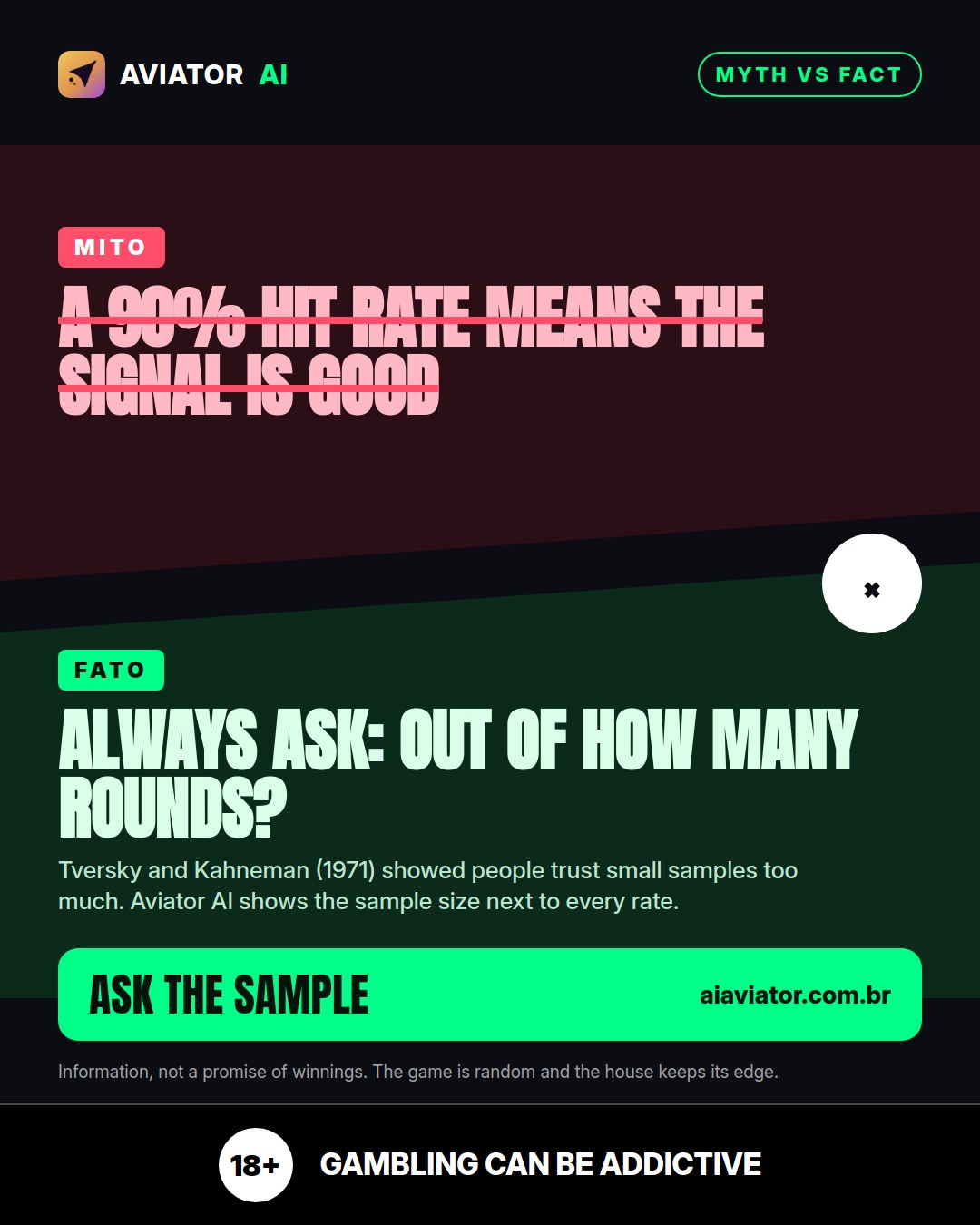
Is a high hit rate proof that the signal is good? Ask: over how many rounds?
A hit rate only means something when it comes with the sample size. See why the number of rounds matters more than the isolated percentage.
 EN
 PT
 HI
 ES
When a product advertises a high hit rate, the natural reaction is to trust it. A large, round number seems like sufficient proof. But today's tip is precisely to distrust that impulse: a hit rate without the sample size is advertising. Before asking how high it is, ask: over how many rounds?
Why a small sample misleads
According to Tversky and Kahneman (1971), people treat a small sample as if it represented the whole. As a result, a rate obtained from few cases seems more convincing than it should. The brain likes patterns and tends to see regularity where there is still only noise.
In practice, this means that five consecutive hits impress far more than they should. A result can look excellent precisely because the number of observations is too low to reveal the real picture.
What Aviator AI shows
The app's practice is to publish a rate together with the number of rounds that support it. The correct reading of any system indicator starts there: the percentage only carries weight when the base that generated it is also visible.
Up to the start of measurement, Aviator AI monitored 181,230 rounds and generated 153,553 predictions. These are context numbers to understand the scale of the tracking, not guarantees about the next result.
How to read a number before trusting it
- Always look for the sample size next to the rate.
- Be wary of high percentages based on few cases.
- Check whether the analyzed period is continuous or was chosen selectively.
- Compare the result with the total number of rounds, not just the hits.
In the app
Aviator AI presents each indicator together with the number of rounds measured, so you can evaluate the statistical basis before drawing any conclusion. The tool is a source of information about the game, and the history of hits and misses is exposed precisely so that the context is not hidden.
Responsible gaming matters. This content is exclusive to those over 18. Information about the game, not a promise of winnings. Past results do not determine future ones. If gaming stops being fun, seek help and set limits before continuing.
Frequently asked questions
See the questions section below.
Sources
Frequently asked questions
Does a high hit rate already prove that a method works?
Not necessarily. According to Tversky and Kahneman (1971), small samples tend to seem more convincing than they should. Without the number of rounds, the rate does not allow its reliability to be assessed. Information about the game, not a promise of winnings.
Why does Aviator AI show the number of rounds alongside the rate?
Because an isolated percentage can lead to wrong conclusions. The app tracks 181,230 monitored rounds since the start of measurement, and the size of the base must appear alongside any rate so it can be read correctly. Past results do not determine future ones.
How do you know whether a sample is large enough?
There is no magic number that works for every case. The key point is to distrust any high percentage obtained from few observations and to compare the result with the total number of rounds analyzed. Information about the game, not a promise of winnings.
Share