Set your limit before playing Aviator AI
Why the limit needs to be decided before the first round, and how the feeling of control and near-misses can get in the way of that decision.
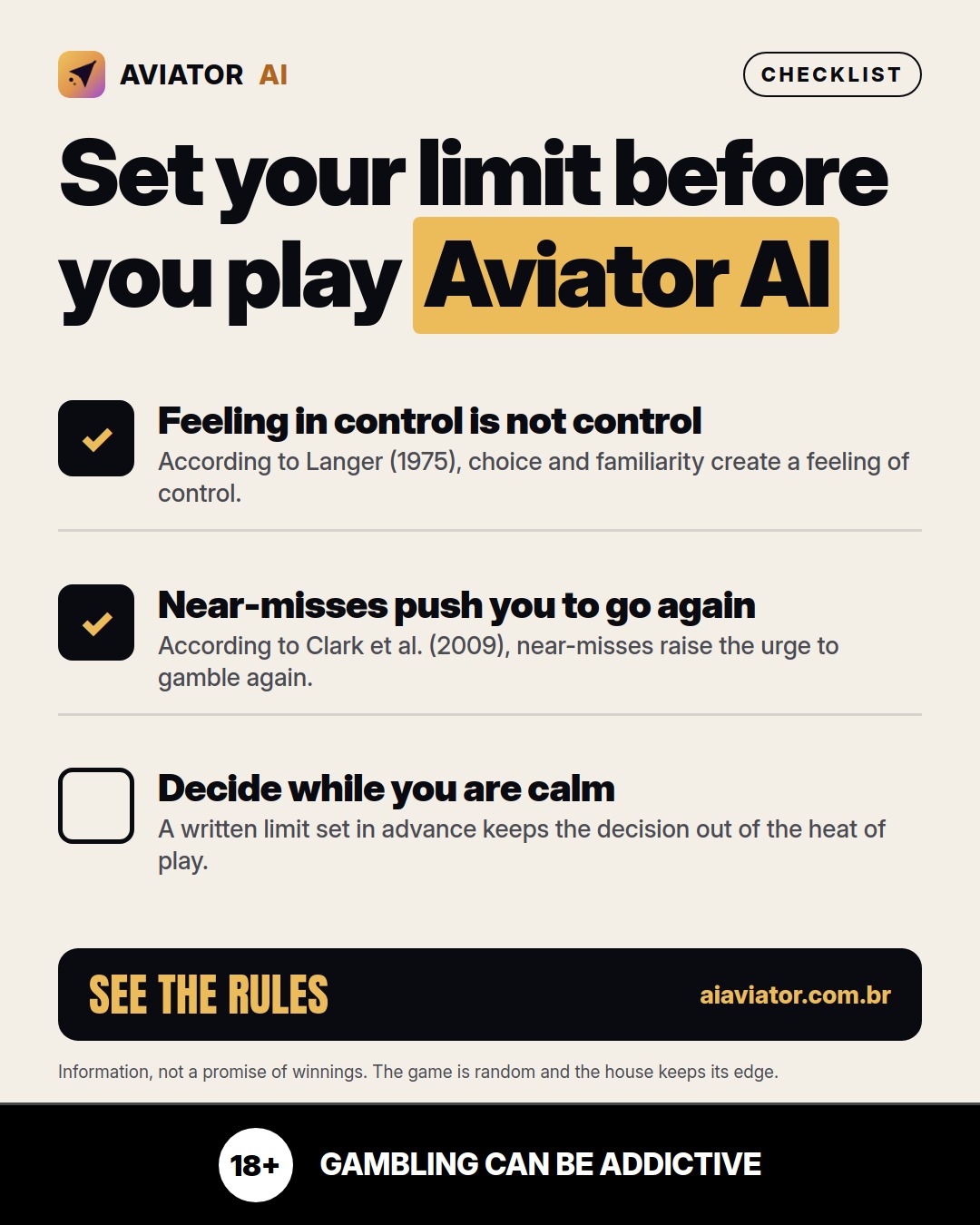 EN
 PT
 HI
 ES
Set your limit before playing Aviator AI. It sounds simple, but it is precisely the decision that gets lost most often once the game has started. Players who enter without a defined loss amount and time tend to adjust these numbers on the fly, with their minds occupied by the last round. Today's tip starts from this idea: the best time to decide how much you are willing to lose is before you begin.
A sense of control is not control
According to Langer (1975), choice and familiarity create a sense of control even when the outcome depends only on chance. In other words, the fact that you choose when to enter, the amount of the bet, or the button to press can give the impression that you are influencing the result, when you are not. In Aviator, where each round is independent and the app cannot predict the next one, that impression is misleading.
For this reason, a feeling of mastery should not replace a written limit. It is strongest precisely when the person feels confident, and it is in that state that the limit is usually ignored. Defining the maximum loss before the first round helps separate the feeling from what is actually happening.
Near-misses push you to play again
According to Clark et al. (2009), near-misses increase the motivation to bet again. When the plane flies away shortly before the desired point, the brain registers something close to a win, and the urge to try once more grows. This effect works against the limit: with each near-miss, the decision to stop becomes harder.
It is worth noting that a near-miss carries no information about the next round. It only produces a sense of closeness. Having the limit defined before starting gives you a concrete reference point for those moments when the urge to continue seems reasonable.
Decide with a clear head
A limit written down before playing takes the decision out of the heat of the moment. By defining how much to lose and how long to play, you turn a choice that would be made under emotion into one made calmly. You do not need to be an experienced player to do this: just note the values before opening the game and respect them afterward.
If the limit is reached, the rule is to stop, without recalculating or trying to recover what was lost. This is the point where the tip stops being theory and becomes a habit. Those who treat the limit as part of the game, not as an obstacle, tend to feel less financial strain.
In the app
- Aviator AI monitors rounds live and publishes what it measured, hits and misses included.
- Rounds monitored since the start of measurement: 174,213.
- Predictions generated to date: 147,124.
- The app presents information about the game. It does not promise winnings or indicate where or how much to bet.
Gambling is for adults 18 and over. If the game stops being fun, seek help: anyone who feels they have lost control should seek professional support or talk to someone they trust before continuing. Set your limit before playing and respect it, always.
Why set the limit before and not during?
Because during the game, emotion, the feeling of control, and near-misses are all acting at the same time. Deciding beforehand allows you to think with less pressure.
Sources
- Langer (1975) — The illusion of control (Journal of Personality and Social Psychology)
- Clark et al. (2009) — Gambling near-misses enhance motivation to gamble and recruit win-related brain circuitry (Neuron)
Frequently asked questions
Why does the feeling of control mislead you in Aviator?
According to Langer (1975), choice and familiarity create a sense of control over outcomes that are pure chance. In Aviator, each round is independent, so that feeling does not match what actually happens.
Do near-misses show that the next round will go better?
No. According to Clark et al. (2009), near-misses increase the urge to bet again, but they carry no information about the following round. Past results do not determine future ones.
What should you do when the limit is reached?
Stop. The limit should be set before starting and respected afterward, without trying to recover losses. Information about the game, not a promise of gain.
Share