1 in 83 adults: what the WHO says about gambling disorder
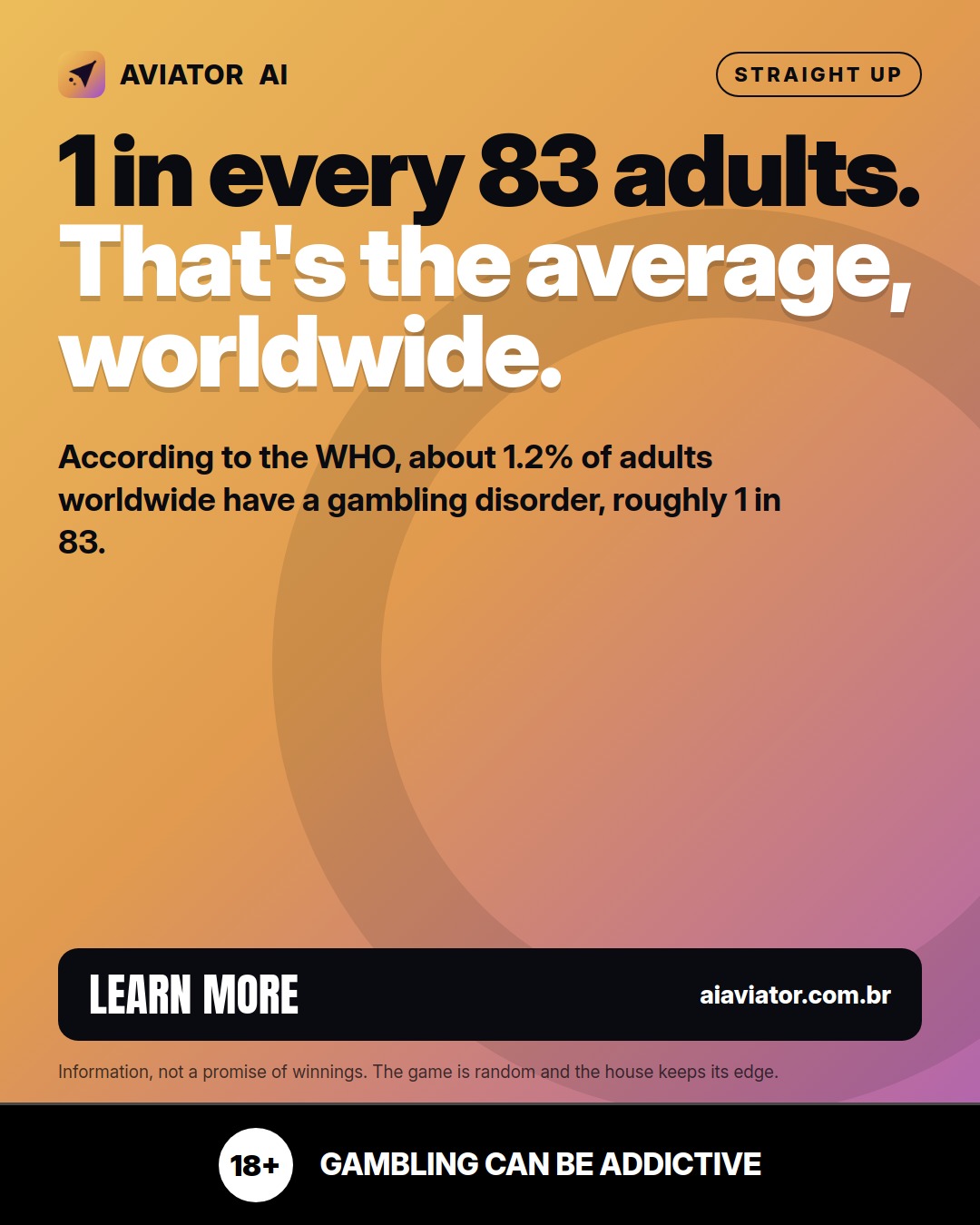
According to the WHO, about 1.2% of adults worldwide have gambling disorder, roughly 1 in 83. Understand what this figure means and what Aviator AI measures.
 EN
 PT
 HI
 ES
1 in 83 adults. That is the global average. According to the World Health Organization (WHO), about 1.2% of the adult population on the planet has gambling disorder. Dividing 1 by the percentage gives us something close to 1 person in every 83. Today's tip starts from this number because it changes how we think about gambling: it is not a rare problem that happens to other people, it is a condition that appears with real frequency in society.
What the WHO means by gambling disorder
According to the WHO, gambling disorder is characterized by a persistent or recurrent pattern of gambling behavior in which the person loses control over the frequency, duration and intensity of their bets, keeps playing despite growing losses, and starts giving priority to gambling over other areas of life. It is not only about spending a lot of money: the central criterion is the loss of control and the negative impact on daily life.
This understanding matters because it shows that the risk does not depend on who is "weak" or "strong". Anyone can develop a problematic pattern, especially in fast and repetitive game environments, such as crash games.
How to read the number without drawing wrong conclusions
A population statistic describes the group, not the individual. Knowing that about 1.2% of adults are affected does not let you predict who will be, or when. It also does not let you calculate outcome probabilities in any game. This kind of reading is exactly what this tip aims to avoid: turning a public health statistic into a promise of winnings or into a "signal" for playing.
- The WHO figure is a population health estimate, not a measure of chance in rounds.
- It serves to understand the size of the problem, not to decide bets.
- Anyone who promises predictions based on it is just using a number with a scientific appearance.
What Aviator AI actually measures
Aviator AI tracks live rounds and publishes what it measured: hits, misses and the patterns observed. Since measurement began, 172,906 rounds have been monitored and 152,217 predictions have been generated. These numbers describe the system's own history and are released with the same transparency with which we show our errors.
To be clear: rounds have no memory, and no one can safely predict the next one. What the app does is record what happened and show that record, without promising future results.
In the app
- History of monitored rounds, with hits and misses published.
- Panel with the predictions generated and the performance measured over time.
- Tools to keep track of your own gambling behavior and set limits.
Playing involves risk, and the money spent can be lost. If you notice that the game is taking up time, space or resources that should go to other areas of your life, stop and seek help. This content is intended exclusively for people over 18.
Sources
Frequently asked questions
Does that mean 1 in every 83 people who play will have problems?
No. The WHO figure refers to adults in the world population, not to people who play. It indicates how common the disorder is in society, not an individual prediction.
Can Aviator AI predict the next round using this data?
No. Rounds have no memory and the app does not predict the next round. What it does is monitor live rounds and publish what it measured: so far 172,906 rounds have been monitored and 152,217 predictions generated, with hits and misses released.
Where can I get help if gambling is getting out of control?
Seek a health professional or a support service specialized in problem gambling in your region. Information about the game, not a promise of winnings. Past results do not determine future ones.
Share