Illusory control: why choosing when to cash out doesn't move the plane
The feeling of influencing chance is common in crash games. Understand why choosing when to cash out is your decision, not a lever over the outcome.
 EN
 PT
 HI
 ES
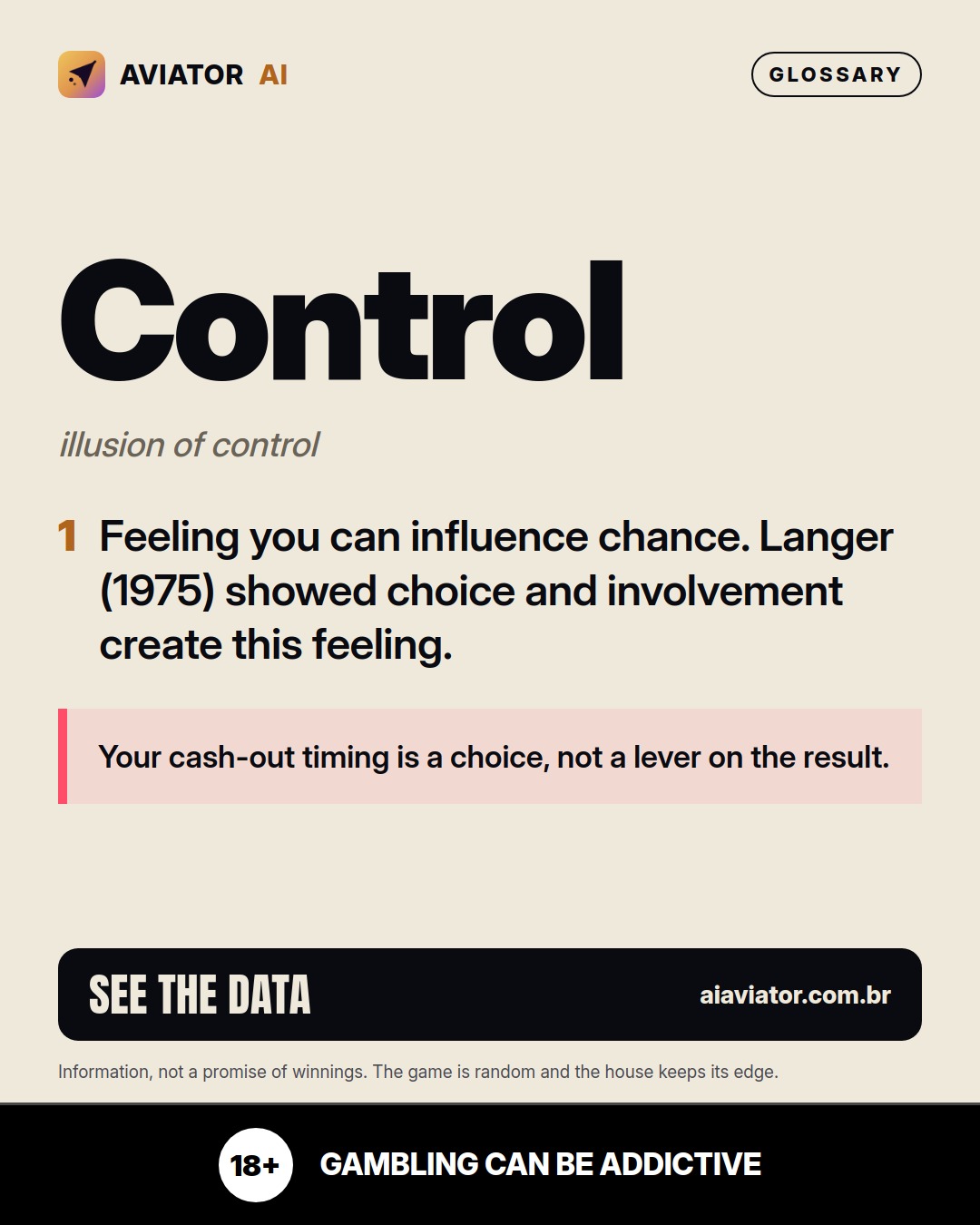
Today's tip is about a feeling almost every crash player knows: the impression that, by choosing the moment to cash out, you are somehow influencing the flight. According to researcher Langer (1975), choice, familiarity and involvement create this sense of control even when the outcome is pure chance. The tip published on social media sums up the idea: choosing when to cash out feels like skill, but the plane is the one that decides.
Where the sense of control comes from
According to Langer (1975), people tend to feel in charge of outcomes that are pure luck when elements such as choice, familiarity with the situation and active involvement are present. In Aviator, all three are present: you choose the amount, you choose the moment to click and you follow the curve rising in real time. These details make chance feel like a skill.
This explains why small decisions, such as cashing out a little earlier or a little later, carry a far greater emotional weight than they actually have on the outcome of the round.
The cash-out decision is yours, the result is not
It's worth separating two things. Cashing out is your decision: you can choose the point at which you end your participation. The multiplier at which the plane crashes, however, is set by the game's system in every round, and you do not control it. When you cash out, you are only deciding at which point of the curve you stay, without altering the curve itself.
That is why a streak of successful cash-outs does not prove you have mastered the game. It may simply be chance over a favorable stretch, and the same strategy can fail right after without anything having changed in the way you play.
In the app
Aviator AI does not promise to predict the next round. The app reads the rounds live and publishes what it measured, including hits and misses. So far, 172,734 rounds have been monitored since measurement began, and 151,422 predictions have been generated. These numbers serve to track the history of what the system recorded, not to indicate what comes next.
- Follow the history of rounds measured by the app, with hits and misses.
- Compare the sense of control with what was actually recorded.
- Treat each round as independent, without looking for patterns in the past.
Play responsibly
Crash games are for adults aged 18 and over. If you feel you need to recover losses, increase bets to feel in control, or that the game is disrupting your routine, stop and seek help. Information about the game, not a promise of gains. Past results do not determine future ones.
Understanding that the plane decides is the first step toward playing with less illusion and more clarity about what is actually in your hands.
Sources
Frequently asked questions
Does choosing when to cash out increase my chances of winning?
No. Cashing out is a decision about when you end your participation. The multiplier at which the round ends is set by the game and does not change with your choice. Information about the game, not a promise of gains.
Why do I feel I have control over the result?
According to Langer (1975), choice, familiarity and involvement create the sense of control over outcomes that are pure chance. In Aviator, you choose the amount and the moment to cash out, which reinforces this impression.
Can the app predict the next round?
No. The app reads the rounds live and publishes what it measured, with hits and misses. So far, 172,734 rounds have been monitored and 151,422 predictions generated. Past results do not determine future ones.
Share