False reputation: 5,000 downloads and the tool was still malware
Downloads, stars, videos and 'safe' votes can be faked. See what Check Point Research reported and the habit that helps check a tool before you trust it.
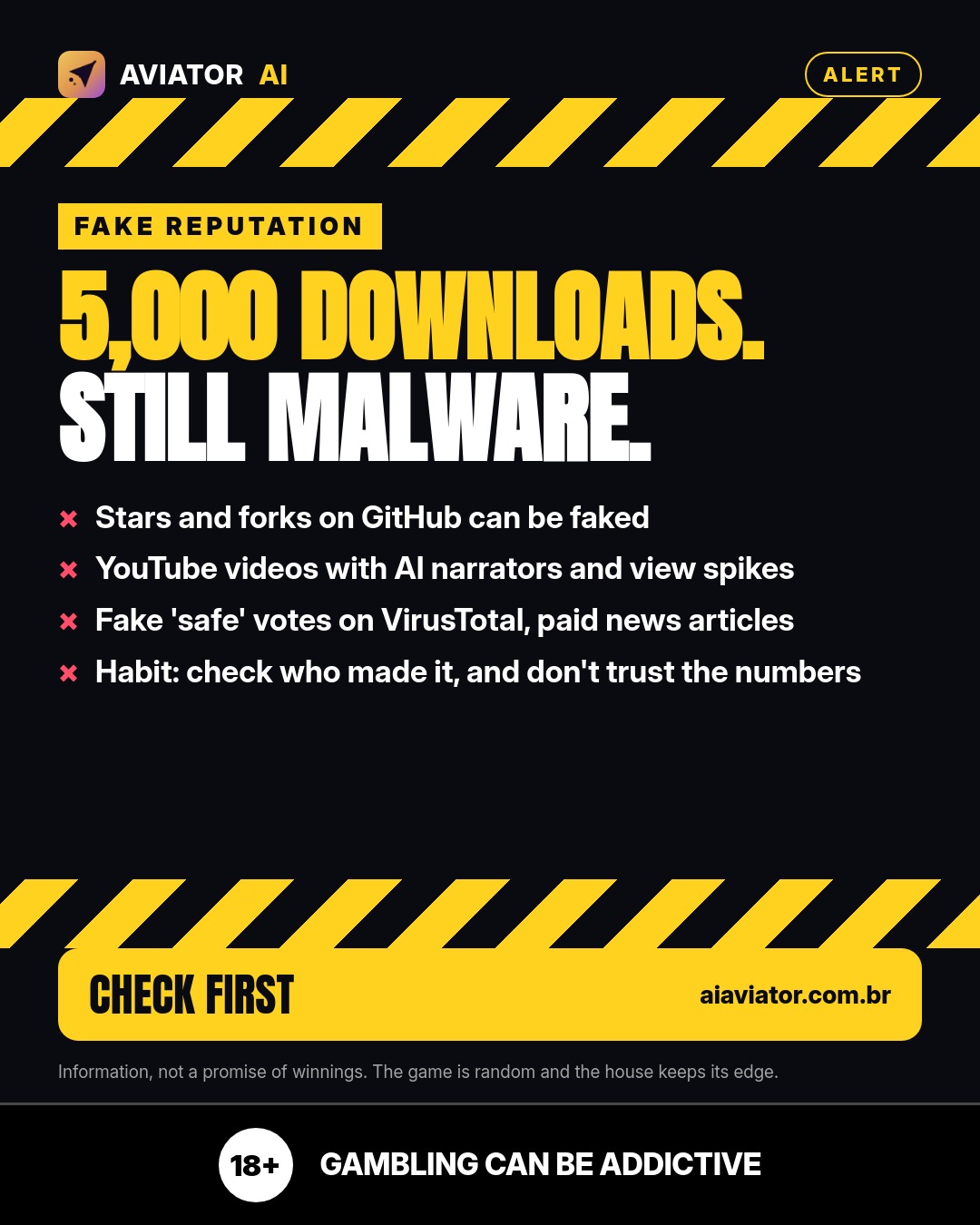 EN
EN PT
PT HI
HI ES
ESDownloads, stars, videos and 'safe' votes can all be faked, so it's worth checking a tool before trusting it. That's the idea behind today's tip, which has already circulated on our social networks: 5,000 downloads. It was still malware. Here we develop the reasoning calmly, because a pretty number on the screen proves nothing about who is behind it.
Stars and forks on GitHub can be fake
According to Check Point Research, in 2026, a malware campaign deliberately built a false reputation. One of the pillars was stars and forks on GitHub, in a project that passed 5,000 downloads. To an outside observer, this combination looks like a sign of popularity and community approval.
The problem is that stars and forks are counters, and counters can be inflated. When popularity is manufactured, the number stops measuring what we think it measures. A project full of stars and downloads may have gotten there without a single real person having evaluated the code.
YouTube videos with AI narrator and view spikes
Still according to Check Point Research, the same campaign used YouTube videos with an artificial intelligence narrator and spikes in views. A tutorial video creates a sense of social proof: someone showed the tool working, and many people watched it.
But an AI narrator doesn't require a real person behind it, and a spike in views doesn't say who watched or why. The tip here is to be wary of the whole package: a well-produced video, lots of views and lively comments may all be part of the same staging. The appearance of trust is not trust.
Fake 'safe' votes on VirusTotal and paid articles
Check Point Research also reported that the campaign planted fake 'safe' votes on VirusTotal and paid for articles on news sites. This touches two of the most common reflexes of anyone who wants to check before installing: looking at the security reputation and searching for mentions in the press.
If even the 'safe' badge and a news site article can be bought or forged, no single signal is enough. The more convenient signals appear all at once, the more reason to stop and ask where they came from.
Habit: look at who made it and don't trust the numbers alone
The habit that sums it all up is to look at who made the tool before looking at how many people downloaded it. Who is the author? Is there verifiable history? Is there real discussion, with people pointing out problems, or just uniform praise? Numbers are easy to fabricate; a consistent track record from an identifiable person or team takes more work.
When in doubt, the best path is usually the slowest: don't install in a rush, be suspicious of excessive enthusiasm, and prefer sources you can trace back to an origin.
In the app
Aviator AI follows the same logic: showing what was measured, not what sounds convincing. The app reads the rounds live and publishes what it measured, with hits and misses in plain sight. Since the start of measurement, 199,347 rounds have been monitored and 195,782 predictions generated, numbers you can check in the app's own history, without relying on anyone's promise.
Here, no one predicts the next round: rounds have no memory. What the app does is record and show what happened.
Responsible gambling
Content for 18+. Information about the game, not a promise of winnings. Past results do not determine future ones. Play consciously and stop if it stops being fun.
Sources
Frequently asked questions
Do many downloads mean a tool is trustworthy?
Not necessarily. According to Check Point Research, a malware campaign had more than 5,000 downloads with a reputation built falsely, including stars and forks on GitHub.
Does a 'safe' vote on VirusTotal settle the question?
Not on its own. Check Point Research reported that the same campaign planted fake 'safe' votes on VirusTotal, in addition to paid articles on news sites. That's why it's worth checking who made the tool.
Does Aviator AI predict the next round?
No. Rounds have no memory and no one predicts the next one. The app reads the rounds live and publishes what it measured, with hits and misses: 199,347 rounds monitored and 195,782 predictions generated since the start of measurement.
Share