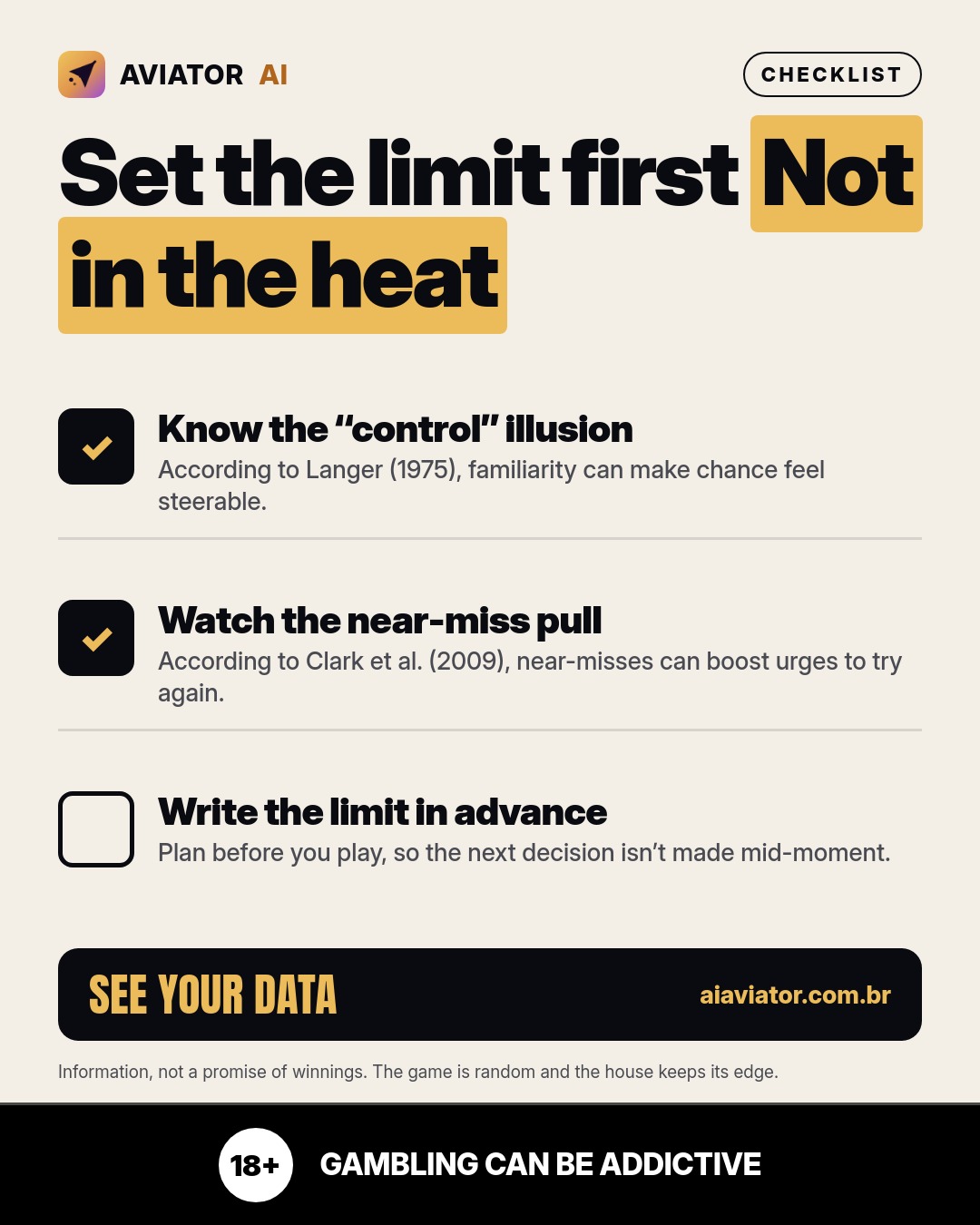
Set it first: the limit is not born in the "hot" moment
The tip is simple: set your limit before you play. That way, you reduce two common effects — the illusion of control and the pull of the near miss — which tend to act on the impulse of the moment.
 EN
EN PT
PT HI
HI ES
ES"Set it first, not in the moment": the "hot" side of the moment tends to push unplanned decisions. When you leave the limit for later, the app keeps measuring the rounds, but your choice becomes more vulnerable to illusions and triggers like "so close".
1) See the illusion of control
According to Langer (1975), the way people perceive their own choice — with familiarity and involvement — can create a sense of control over outcomes that, in practice, are pure chance. In other words: when you feel "in control", the brain tends to interpret the scenario as more "directable" than it really is.
This often appears precisely when the person starts playing without a limit already decided. The environment gains emotional weight, and the sense of familiarity can reduce attention to what matters: respecting a participation ceiling defined in advance.
2) Beware the pull of the near miss
According to Clark et al. (2009), near-misses (almost-hits) increase the motivation to try again. The "almost" activates the sense of closeness and can turn a result that did not complete the objective into an invitation to keep going.
In day-to-day play, this affects the rhythm of the decision. When you have not defined a limit beforehand, the near miss can become the emotional argument: "just one more try". The problem is that the impulse comes first and the limit is left behind.
3) Write the limit before you play
The third tip is practical and direct: decide calmly before you start. The idea is not to "react" to what is happening in the moment; it is to put in writing (or mentally, but firmly) what the ceiling is that you will respect until the end of your session.
With that, you avoid letting the choice be born in the heat of the moment. Since behavior changes when the decision is made under emotion, the limit defined beforehand works as a brake for the two effects mentioned: the illusion of control and the pull of the near miss.
In Aviator AI, monitoring follows the live rounds and publishes what it has measured over time. Since the start of measurement, 288.175 rounds have been monitored, and the system generates 391.453 predictions. This reinforces a point: the result is part of the game, and what you truly control is your own limit.
In the app
In Aviator AI, you follow what is being measured in the rounds and see the predictions the system generates during the session. Use these data as a reference for what is happening now — and, above all, keep your limit defined before you play.
Responsible gaming: 18+. Plan your limit in advance and play only what you can lose. This information is for support and awareness, with no promise of outcome.
Game information, not a promise of winnings. Past results do not determine future ones.
Sources
- Langer (1975) — The illusion of control (Journal of Personality and Social Psychology)
- Clark et al. (2009) — Gambling near-misses enhance motivation to gamble and recruit win-related brain circuitry (Neuron)
Frequently asked questions
Why does "deciding before" make a difference when playing?
According to Langer (1975), familiarity can create a sense of control over chance outcomes. By defining the limit beforehand, you reduce the chance of acting on the impulse of that feeling.
What exactly is the "pull of the near miss" that the tip mentions?
According to Clark et al. (2009), near-misses increase the motivation to try again. This effect can lead you to keep going, even without a limit already defined.
What does Aviator AI measure for me to follow during the session?
The app monitors the rounds over time; since the start of measurement, 288.175 rounds have been monitored, and the system generates 391.453 predictions.
Share