Martingale math: Walk to the wall (Tip of the day)
The martingale grows in steps: after losses, the bet doubles the base. In the standard model, the sequence runs into a finite limit.
 EN
EN PT
PT HI
HI ES
ES“Martingale math: Walk to the wall”. The idea that circulates is simple: after a loss, the next bet doubles the base. But this “step-by-step math” has an unavoidable side effect when the bankroll and the limits are finite — and that is exactly what Aviator AI helps observe in the real world of the game.
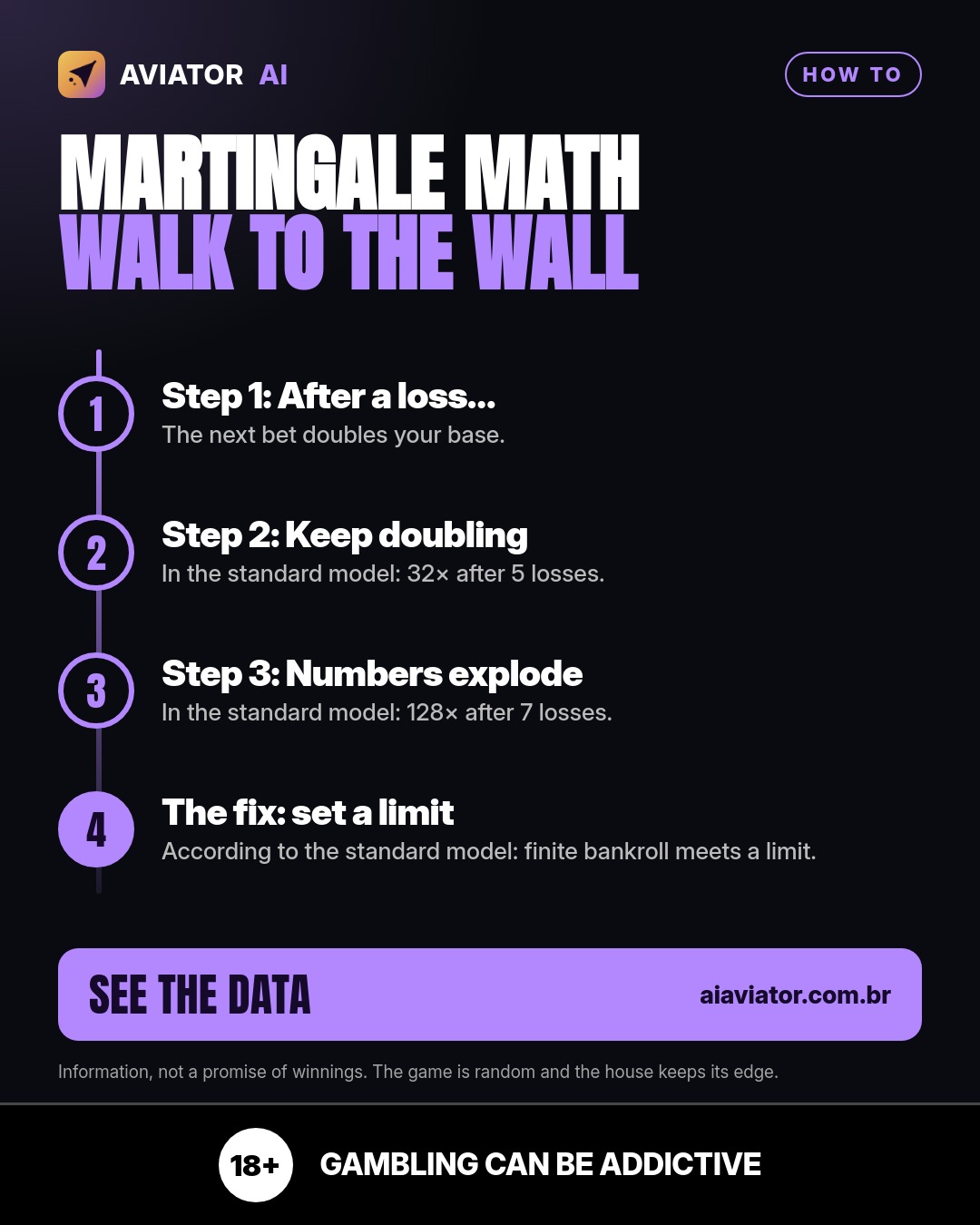
Step 1: After a loss… the next bet doubles the base
In martingale, the mechanism is straightforward: each time a loss comes up, you adjust the bet to be double the base. The logic behind the move is countable and, in the standard model, follows a pattern: after 1 loss, the next one is 2 times the base.
And the count keeps scaling up in the next steps. Still in the standard model, the sequence reaches 32 times the base after 5 losses and 128 times after 7 losses. It is not “feeling”: it is arithmetic applied to the method’s own adjustment.
When the measurement happens live, the question stops being “whether it will work on paper” and becomes “what happens when the sequence meets the limits?”. Aviator AI monitors the games based on rounds that have already accumulated 378.346 rounds since the start of measurement and generates 445.280 forecasts. It is an environment where the mathematical pattern meets the reality of the limit.
Step 2: Always doubling… and the model goes to 32× after 5 losses
The rule “always double” creates a single path: if the loss repeats, the bet size also repeats the progression. According to the own derivation (simple arithmetic), after 5 losses the next bet is 32 times the base — always in the standard model.
This point often goes unnoticed in quick discussions, because the focus shifts to the attempt to “recover” what was lost. But the method’s math is indifferent to the goal: it only responds to what happened before, loss after loss, pushing the bet size upward in defined steps.
In the app, tracking what is measured over the rounds helps turn the discussion into observation. Instead of treating the method as abstract theory, you begin to see how growth in steps coexists with the fact that there is a practical limit to what can be sustained.
Step 3: Numbers grow… and in the standard model it reaches 128× after 7 losses
If the process continues without breaking the sequence, martingale follows the trail of doubling. According to the own derivation, in the standard model the bet reaches 128 times the base after 7 losses. It is the same mechanism, just on another scale.
And that is where the part many people ignore comes in: limits are not opinion. The own derivation also states that, since the bankroll and the table are finite, a sequence of doublings will inevitably reach one of the limits eventually — always in the standard model. In other words: “walking to the wall” is not an empty metaphor; it is the consequence of growing without stopping.
What Aviator AI does with your routine is keep this theme visible: you look at what was measured, check what was forecast, and compare it with what happened. With 378.346 monitored rounds and 445.280 forecasts generated, the tip stops being debate and becomes practical learning about the game’s behavior over time.
In the app
In Aviator AI, you follow the signals and the performance of what was measured in the rounds, with comparisons of the forecast versus what happened. This tracking is the bridge to applying the tip consciously: understanding that, if the method grows in steps, it also meets limits when the sequence persists.
Responsible gaming: 18+. Game information, not a promise of winnings. Past results do not determine future ones.
FAQ
Frequently asked questions
What happens to the next bet after 1 loss, in the standard model?
In the standard model, the own derivation shows that the next bet becomes 2 times the base after 1 loss.
How high does the bet go in the standard model after 5 losses?
In the standard model, according to the own derivation, after 5 losses the next bet becomes 32 times the base.
Why does martingale “reach the wall” even in the standard model?
According to the own derivation, in the standard model the bankroll and the table are finite, so a sequence of doublings eventually reaches one of the limits.
Share