2x is not heads or tails: pattern ~48.5% vs. measured window (10/10)
Many people treat 2x as if it were “heads or tails.” But the app shows that the measured window does not follow that pattern exactly. See how to interpret the measurement without predictions.
 EN
EN PT
PT HI
HI ES
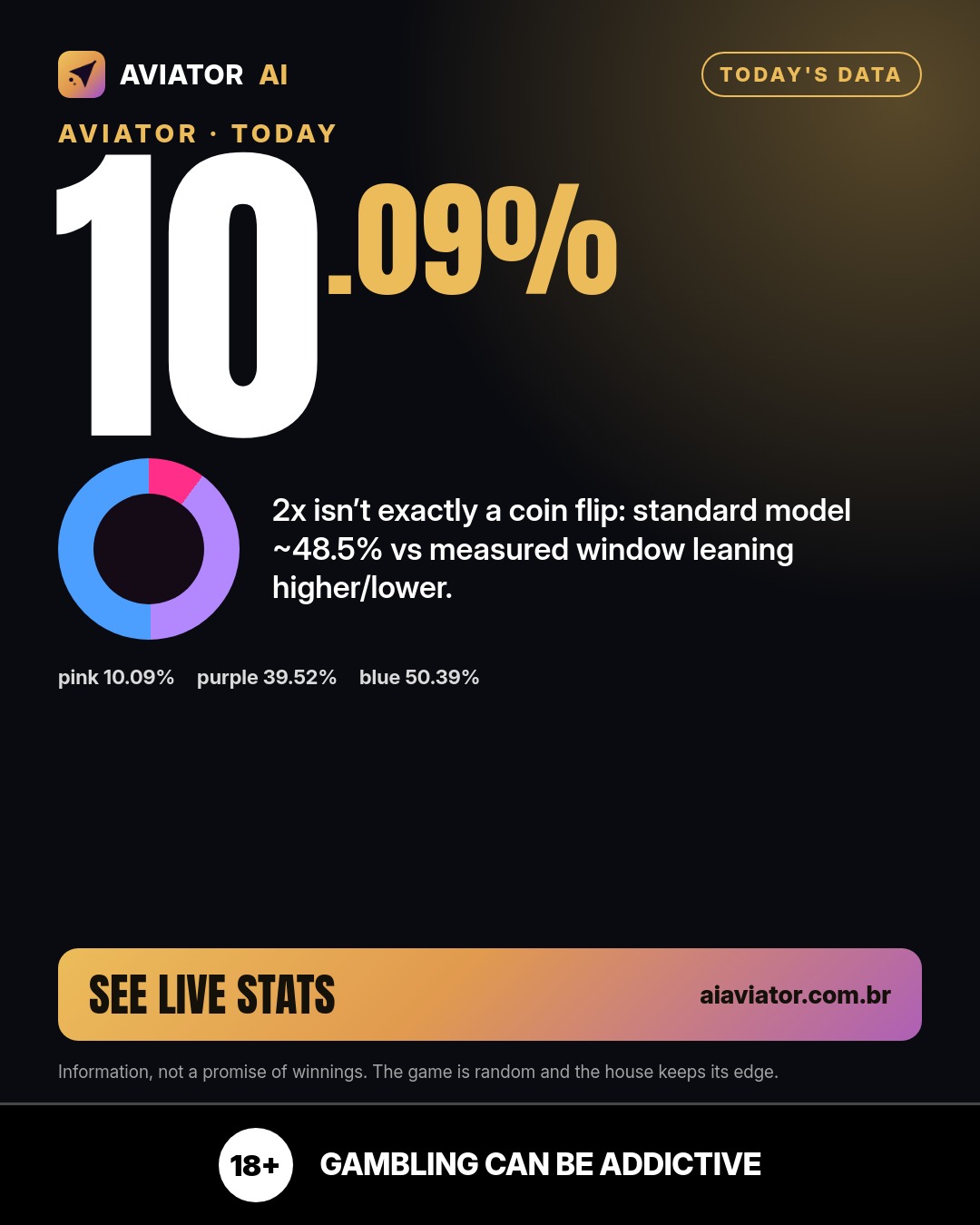
ESToday’s hook is direct: 2x is not exactly heads or tails. The standard model suggests something close to 48.5%, but the app’s reading in the measured window reminds us that, in practice, this does not behave like a “perfect 50/50”.
Why 2x “seems” 50/50 to many people
When someone tries to simplify the behavior of a game with binary outcomes, it is natural to approximate: “passed” or “did not pass.” In the case of 2x, the feeling becomes heads or tails precisely because the topic is usually treated as a simple split into two possibilities.
The point is that this intuition does not replace what the app measures live. Aviator AI monitors rounds in real time and records what happened in the window considered — and that is where the difference between feeling and measurement appears.
What the standard model indicates (and where it helps)
In the standard model, the reasoning can be summarized like this: if the chance of a round “meeting” a repeated event tends to follow the rule of the model itself, then the aggregate probability for 2x ends up close to 48.5%. This is a derivation based on understanding the mathematical pattern, not a published figure.
The value 2x comes in because, in the same model, behavior changes with the number of repetitions required in the reasoning. The practical reading for the user is simple: even if the pattern points to something close to “half,” this does not eliminate variations observed in the real window.
That is where the app comes in as a bridge between model and reality: it does not try to persuade by intuition. It shows what was measured in the rounds that actually passed through monitoring.
The app’s measurement adds context: it is not just theory
To avoid staying only at the “seems” level, it is worth looking at the scale of what Aviator AI has available. According to the product records, since measurement began, 540.022 rounds have been monitored. This helps give weight to what the measured window is showing.
In addition, the app also generates predictions for comparison and internal validation: according to the product records, 757.751 predictions were generated. In other words, it is not just loose observation — there is a cycle of generation and comparison with what happened.
When the tip says “2x looks 50/50… but the measurement shows that it is not quite like that,” it is pointing precisely to this shift between simplified expectation and what the measured window records.
In the app
In Aviator AI, the bridge to put this into practice is found in the monitoring readout itself: follow the window the app is measuring and use the context of those rounds to understand how 2x behaves in practice, without treating it as if it were automatically a static “50/50”.
Responsible gaming: 18+. Use Aviator AI only for information and entertainment. Information about the game, not a promise of winnings. Past results do not determine future ones.
Frequently asked questions
What does the standard model really give for 2x?
In the standard model, the chance is around 48.5% (a derivation of the pattern indicated in the tip).
How many rounds has the app monitored since measurement began?
According to the product records, 540.022 rounds have been monitored.
Does the app only measure results or does it also generate comparisons?
It generates predictions for comparison: according to the product records, 757.751 predictions were generated.
Share