Getting the timing right: why the mind confuses choice with control
The feeling of control emerges when the decision seems “in your hands”. According to Langer, familiarity and involvement increase the belief that choices drive results that, in practice, are more a matter of chance than something “decided”.
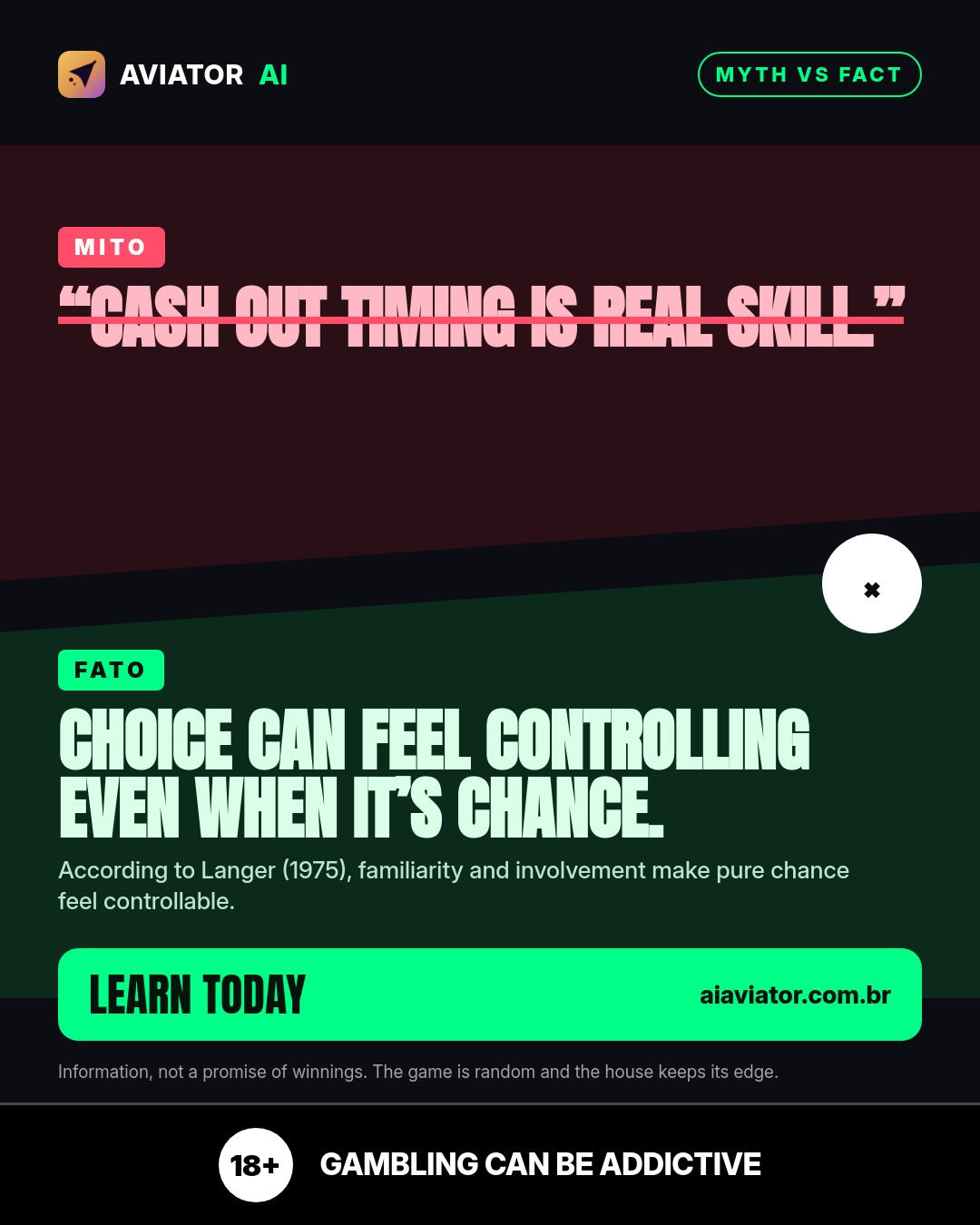 EN
EN PT
PT HI
HI ES
ES“Getting the timing right is a skill.” This kind of phrase sounds convincing because we choose, participate, and follow along—and the brain tries to turn that experience into control. According to Langer (1975), when there is familiarity and involvement, chance starts to seem controllable, even when the outcome depends more on what slips out of our hands than on what was “decided”.
You don’t control the plan—but you feel like you do
Today’s message is straightforward: you do not control the plane, and your brain insists you do. This describes a common mental shortcut: when there’s a visible action (like making a choice at the moment), the mind interprets that the result was driven by that action.
According to Langer (1975), choice, familiarity, and involvement make people feel in control over outcomes that are, for the most part, pure randomness. In other words: the “decision moment” becomes subjective proof that you were in charge.
Why familiarity and involvement increase the feeling of control
In the day-to-day of the game, familiarity shows up when you’ve already seen similar situations, understand the flow, and get used to the rhythm. Involvement grows when you pay attention, follow along, and make decisions during the experience.
According to Langer (1975), this combo—choice + familiarity + involvement—tends to raise the feeling of control. And the feeling itself is strong enough to make randomness seem “directed” by you.
When this logic mixes with language like “knowing how to cash out”, it becomes easier to confuse skill with pattern reading. But, according to Langer (1975), this is exactly where the mind gets it wrong: it doesn’t just participate—it also interprets participation as the cause.
How this connects to the way to use the app
The goal of Aviator AI is not to reinforce “control” over what you can’t control, but to follow what is displayed and measured live: rounds pass and the system records the results, so you can observe the game’s behavior with greater clarity.
To provide context, Aviator AI monitoring has already reached 874.366 rounds since the start of measurement, and the system generated 1.229.512 predictions. These figures help support the core idea: the follow-up comes from the recording of what happened, not from the feeling that a choice “steers” the outcome.
If your brain tries to turn decisions into control, treat your perception as an emotional input—and go back to what the app measures. That way, you separate what is experience (participation) from what is monitoring (a record of what occurred).
In the app
- rounds monitored since the start of measurement: 874.366
- predictions generated: 1.229.512
Responsible game: the decision to participate is yours, but don’t turn the experience into a result promise. Use Aviator AI to track and reflect, respect your limits, and remember that 18+ is a rule: information, not blind betting.
Sources
Frequently asked questions
What are these numbers in the article for?
For monitoring context: Aviator AI counts 874.366 rounds monitored and 1.229.512 predictions generated since the start of measurement.
What Langer (1975) says about “control” in chance?
According to Langer (1975), choice, familiarity, and involvement make people feel in control over outcomes that are pure randomness.
How does the tip apply to the way of thinking about “getting the timing right”?
The headline reinforces that the choice can feel like control even when the result is chance—in the model described by Langer (1975), involvement helps the mind conclude control.
Share