Aviator today 10,01% pink: what the 7-day window shows
Today's card brings together 7.894 rounds and highlights 10,01% pink in the tracked window. The right reading is to look at ranges, context, and limits before making any decision.
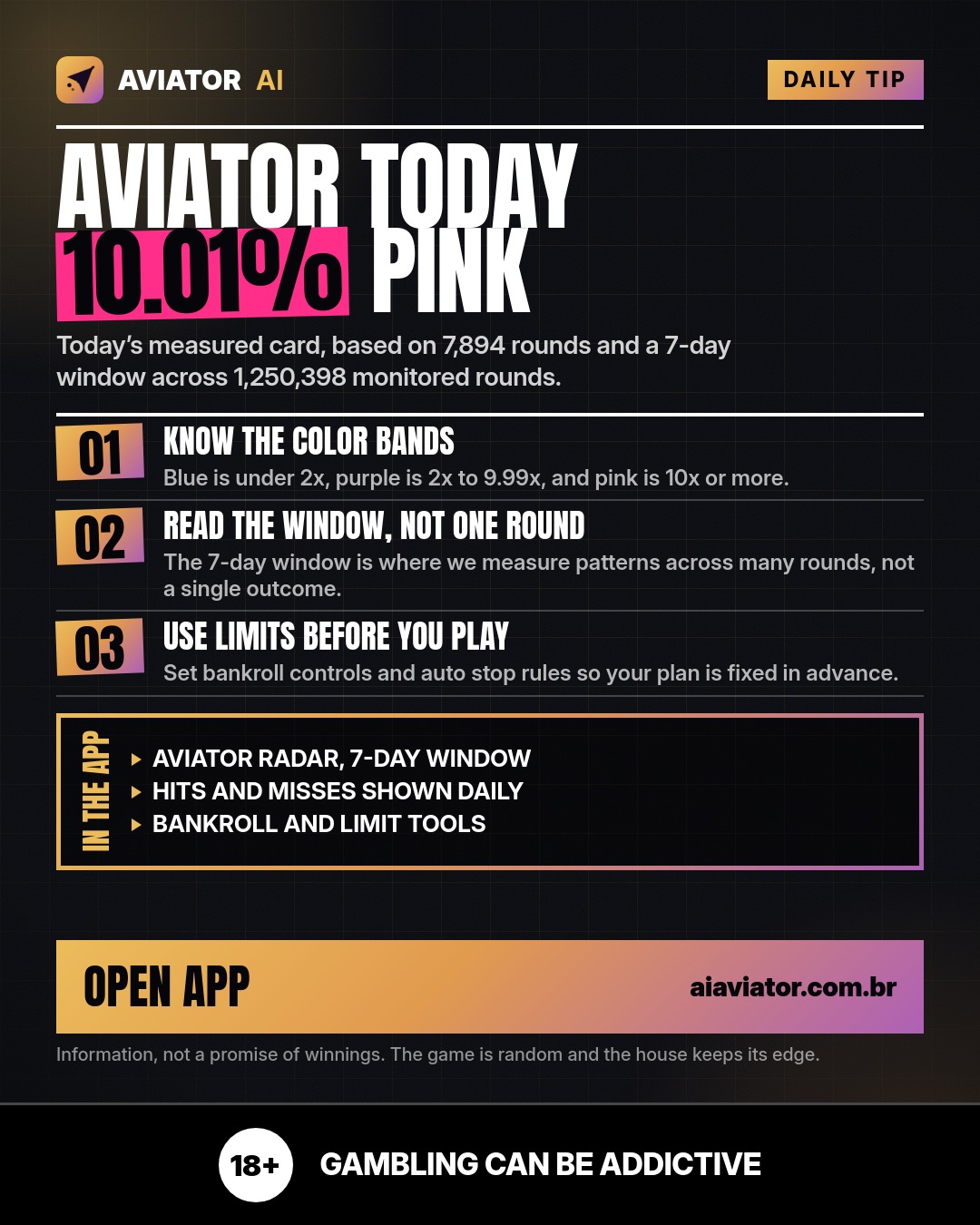 EN
EN PT
PT HI
HI ES
ESToday's highlight is straightforward: Aviator today 10,01% pink. This is the kind of reading that makes sense when you move beyond the impact of the card and into the monitoring context. Today's cut was made based on 7.894 rounds, within a 7-day window tracked over 1.250.398 monitored rounds. The idea is not to look at a single moment and draw hasty conclusions, but rather to understand what the set shows.
Understand the ranges
The first key to the tip is simple: each color represents a different range. Blue appears below 2x, purple goes from 2x to 9,99x, and pink marks 10x or more. When someone reads the card without remembering these ranges, they lose the reference for what is being measured.
That is why the pink highlight is not a visual ornament. It serves to organize the reading of rounds within a specific range. Instead of interpreting the color as an isolated signal, the best approach is to see it as part of a larger portrait of the behavior observed in the window.
This reading avoids confusion between feeling and measurement. Today's card shows a cut with 7.894 rounds, so it makes more sense to think in terms of range distribution than of a single striking result. The color helps classify; the context helps interpret.
Read the window, not a round
The second tip reinforces the central point of the analysis: the 7-day window is where patterns are measured. This means the card's value comes from the accumulated behavior across many rounds, and not from an isolated event that drew attention on its own.
When the reading gets stuck on just one round, the chance of exaggerating the importance of that moment increases. The window, on the other hand, broadens the view and helps reveal whether the range distribution is more concentrated on one side or the other. It is a more stable way to understand what was observed.
In today's case, the cut came from 1.250.398 monitored rounds since the start of measurement, with 1.849.314 predictions generated throughout the process. These numbers reinforce that the published reading does not come from a quick impression, but from continuous tracking of the analyzed history.
Use limits before playing
The third tip moves from reading the card to the user's stance. Before starting, the most important thing is to define bankroll control and automatic stop. This helps keep the process within a plan, instead of letting the decision be driven by the emotion of the moment.
Limit is not an administrative detail: it is part of the organization. When a person already enters with a defined rule, it becomes easier to follow a routine consistent with what was agreed with themselves. The function of monitoring is to inform the scenario; the function of the limit is to protect the course of the session.
This stance fits well with today's reading. If the analysis is based on window and ranges, the attitude also needs to be structured. That way, the card fulfills its role as information, without pushing anyone toward hasty decisions.
In the app
In the app, you will find Aviator Radar with a 7-day window, as well as Hits and misses every day. Bankroll and limit Tools are also available, to turn the card reading into a more organized navigation within the product.
The proposal is to combine monitoring and context in one place. First you see what was measured; then you use the app's resources to understand the distribution, review the history, and apply your own limits more clearly.
Aviator AI is information about the game and reading support, not a promise of gain. 18+.
Frequently asked questions
What does today's highlight mean?
10,01% pink.
What was the basis of today's card?
7.894 rounds.
Which window was used in the reading?
7 days.
Share