Radar reads the window: see ranges, 7-day window and daily scoreboard
Today's tip reinforces the radar's focus on higher-probability windows, not on an isolated round. See how to read the ranges, follow the window and use the daily scoreboard.
 EN
EN PT
PT HI
HI ES
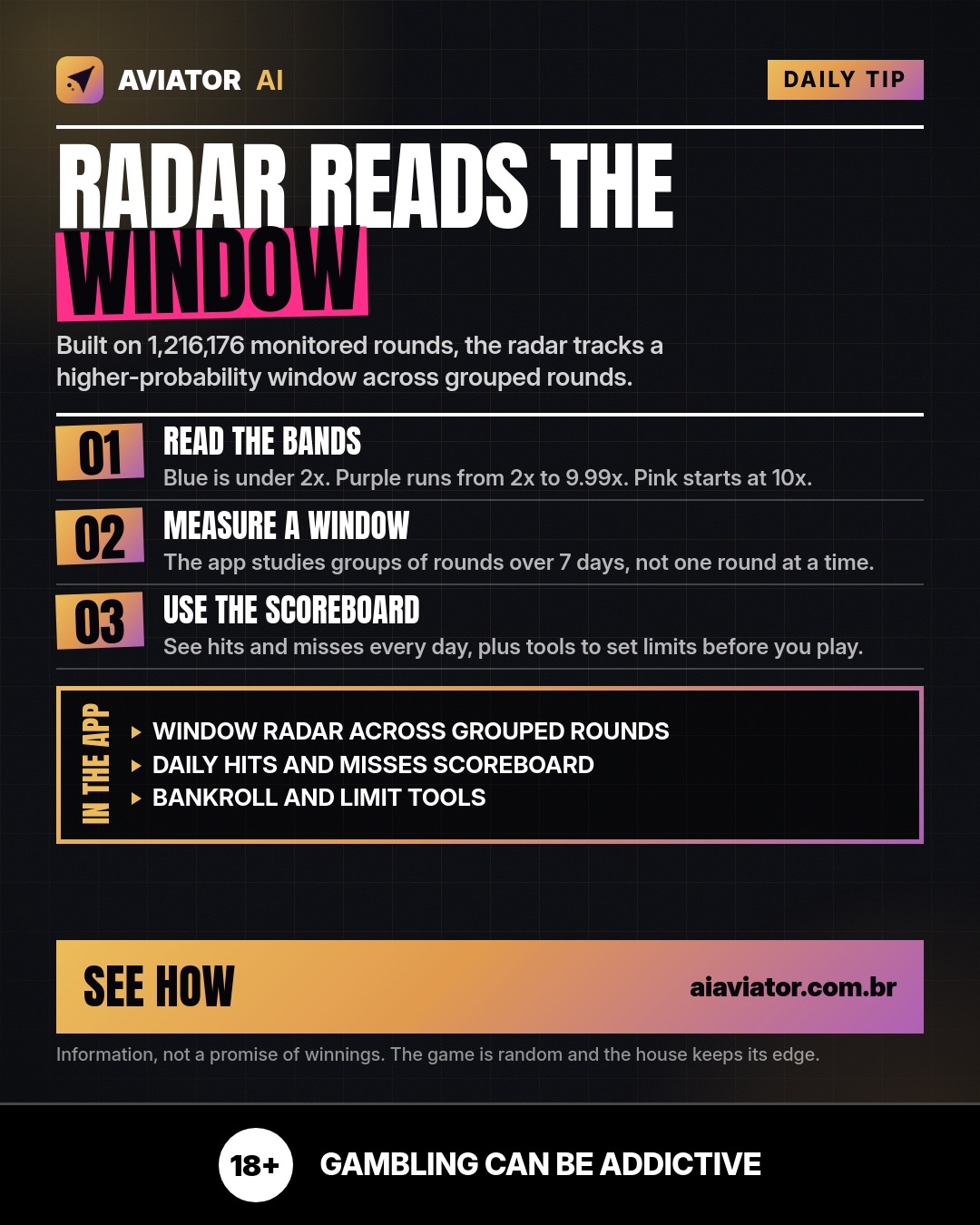
ESToday's headline is direct: Radar reads the window. And the central point remains the same — the system observes groups of rounds, based on 1.216.176 monitored rounds, to highlight a higher-probability window over time, without turning this into reading an isolated round.
See the ranges
The first tip is easy to understand because it organizes the reading by ranges. Blue is below 2x. Purple goes from 2x to 9,99x. Pink starts at 10x. Instead of looking at everything as if it were the same, the radar separates what happened into visual zones that help read the window.
This division is not meant to predict what comes next. It is meant to better see the behavior already measured, because the radar works with a window and not with a single round. When the reading is grouped by range, tracking becomes clearer for those who want to understand what the app is showing in that segment.
It is also worth noting that the color does not change the game; it changes the interpretation of the monitoring. It is a way of reading the distribution of results without mixing everything into the same layer. For those following today's tip, the message is: first see the range, then read the window context.
Measure the window
The second tip reinforces the heart of the radar: the app studies groups of rounds in 7 days, not an isolated round. That is where the idea of a window comes from. Instead of focusing attention on a single outcome, the system compares behavior over the monitored segment.
This matters because the meaning of the reading changes when the focus stops being a single event. The window helps reveal concentration, dispersion and rhythm within the tracked period. The logic is one of continuous observation, not of reading closed into just one moment.
In today's material, the highlighted phrase neatly sums up this approach: Across 7 days, the radar reads windows — not single rounds. That is the idea that supports the whole tip. The radar does not promise a reading of the next round; it highlights the behavior of the window already measured.
Use the scoreboard
The third tip brings the reading into the practice of daily tracking. The scoreboard shows hits and misses every day, so that observation does not remain loose. That way, the person follows what was measured and better understands how the radar behaved that day.
Along with that, the app offers tools to set limits before playing. This part is important because it puts organization ahead of emotion. The goal is not to chase a perfect reading, but to keep clear criteria during use.
When the scoreboard becomes part of the routine, the window reading becomes more complete. Range, period and daily tracking begin to work together. That is why today's tip insists on observing the measured result and not a bet on a specific round.
In the app
- Window radar in groups
- Daily hits and misses scoreboard
- Bankroll and limit tools
These resources form the bridge between the tip and the product: the group reading, today's scoreboard and the limits defined before action. It is the way to turn what was measured into visual tracking within the app, without leaving the logic of observation.
To close: this content is for 18+ audiences and should be read as information about the game, not as a promise of gain. The value lies in following what was measured, respecting limits and maintaining a responsible relationship with using the app.
Frequently asked questions
Does the radar look at a round or a window?
A window.
Over how many days does the app study the groups of rounds?
7 days.
Which ranges does the app show?
Below 2x, from 2x to 9,99x and from 10x onward.
Share