Long streak without pink: why the feeling that "it's due" is misleading
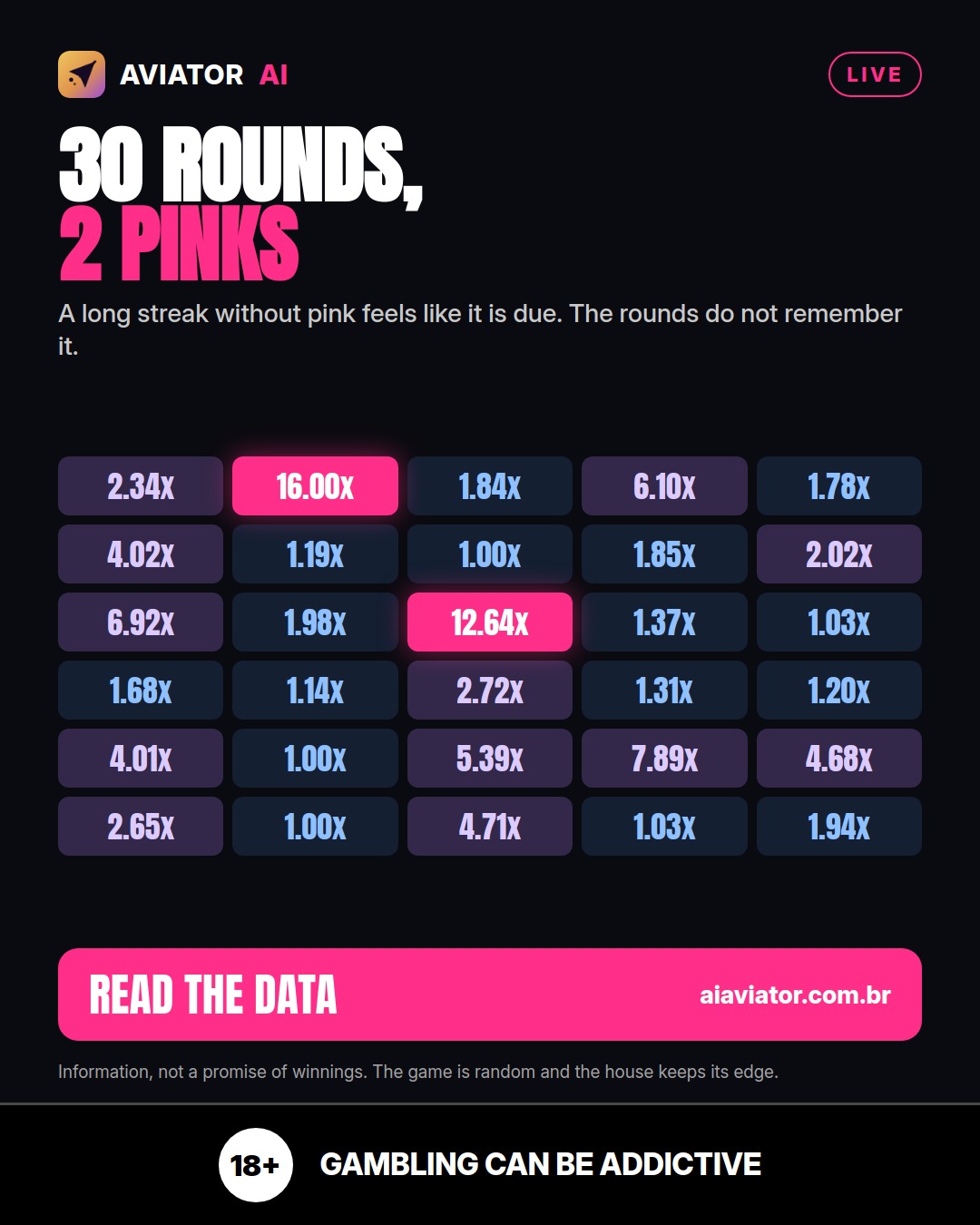
A long run without a pink result seems to call for one soon after. The app measures the rounds live and shows why this impression doesn't hold up.
 EN
 PT
 HI
 ES
Anyone who follows Aviator for a while knows the feeling: it's been quite a while since a pink multiplier came out, and the impression is that it's "due". This intuition is common, but what the app measures in the monitored rounds does not support it. Let's take it step by step.
Where the feeling that it's "owed" comes from
According to Tversky and Kahneman (1971), people tend to treat a small sample as if it represented the whole. When a short sequence goes without a certain result, the mind reads that as a debt that must be paid soon. The problem is that the recent sample is too small to say anything about the whole.
This bias shows up in many contexts, and in the game it usually comes with a silent question: "it hasn't come out for so long, shouldn't it come out now?". The question sounds logical, but it rests on a premise that doesn't exist.
What the app's audit shows about memory
In the Aviator AI audit itself, the rounds of the monitored games show no memory: what happened before does not change the odds of the next round. So far, monitoring has tracked 255,467 rounds since measurement began, and the pattern observed is the same from start to finish: each round is treated as independent.
This means a long sequence without pink does not build up a balance to be compensated. The round that comes next doesn't know how many times pink has failed to appear, so there is no reason to expect it to show up as a form of "settling the account".
Why "whoever promises pink" is guessing
Anyone who confidently claims what the next result will be, or when pink will return, is simply guessing. No method anticipates the next round from recent history, because the history carries no information about what comes after.
If a prediction is presented as certain, the wisest course is to be skeptical of it. What the app does is different: it reads the rounds live and publishes what it measured, including hits and misses, without selling the next result as fact.
In the app
Aviator AI shows the history of the monitored rounds and the log of the predictions generated, 194,011 so far, along with the hits and misses of each one. The idea is for you to see what actually happened, not just the feeling of the moment.
- History of the monitored rounds, read live.
- Log of the predictions generated and what happened after each one.
- Hits and misses displayed side by side, without editing to look better.
Use the app as an observation tool to understand the game, not as a promise of results. Information about the game, not a promise of winnings.
Responsible gambling is for those 18 and over. Set a time and money limit before you start, and stop when you notice you are playing to recover losses. If gambling is interfering with your life, seek help. Past results do not determine future ones.
Sources
Frequently asked questions
If pink hasn't come out for a long time, is it more likely to come out now?
No. According to the app's own audit, the monitored rounds have no memory: what came before does not change the chance of the next round. 255,467 rounds have been tracked under this pattern so far.
Why is the feeling that pink is due so strong?
According to Tversky and Kahneman (1971), people treat a small sample as if it represented the whole. A short sequence without a result feels like a debt, but it is just a sample too small to say anything.
Is there any way to predict the next round?
There is no reliable method for this. Anyone who claims to know the next result is guessing. The app simply reads the rounds live and shows what it measured, including the misses. Past results do not determine future ones.
Share