October 3: “Trust this rate” without a sample size is advertising
When someone “trusts the rate” without saying how many rounds produced that number, the impression can be misleading. In Aviator AI, the rate comes with the measured sample size at the time.
 EN
EN PT
PT HI
HI ES
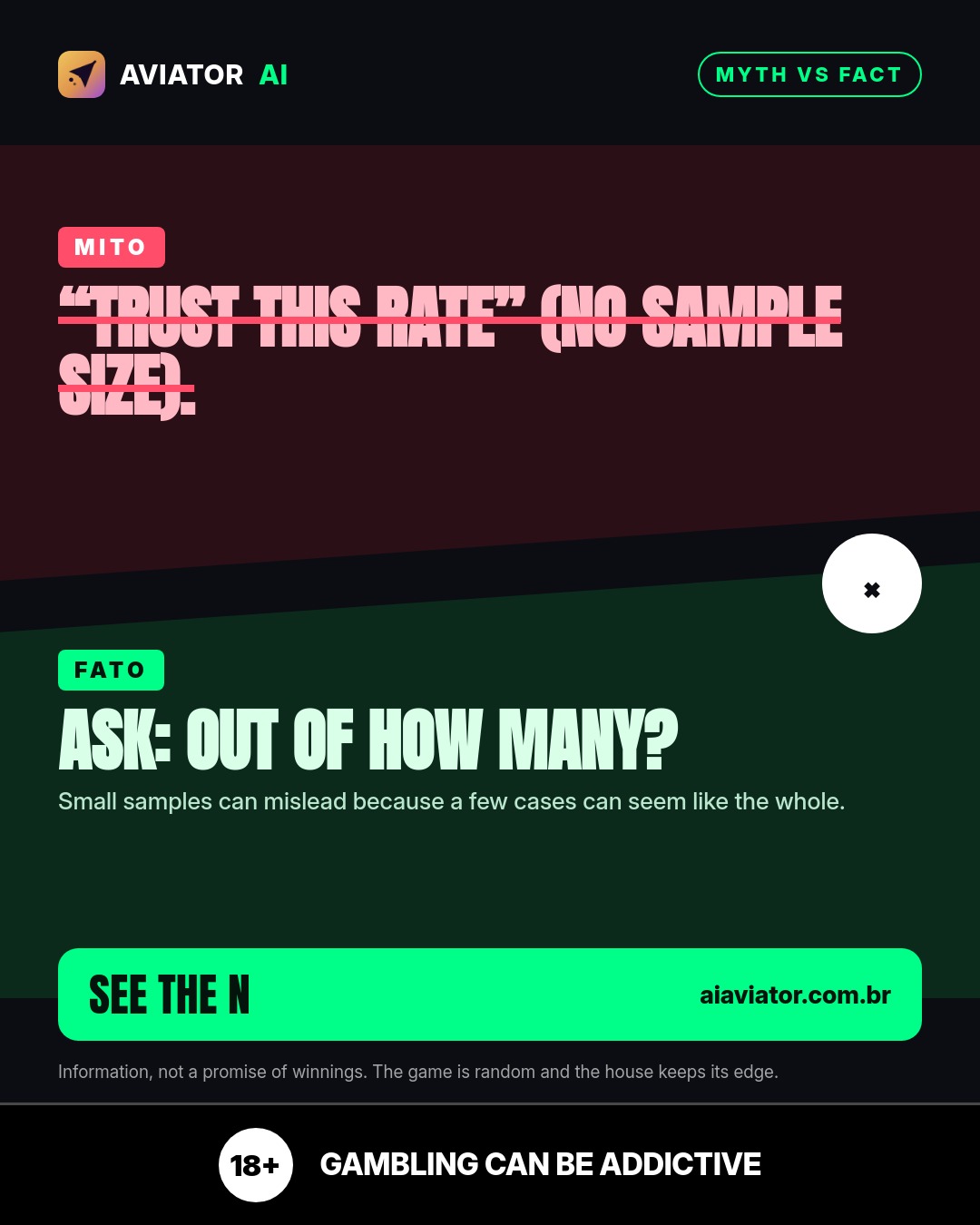
ES“Trust this rate” — without the sample size. The hook is simple: ask how many rounds that rate came from. Because a small sample can mislead, making a few cases seem like the “whole thing”. And that’s exactly where the hit rate without a sample becomes more marketing than measurement.
Why rate without a sample “sounds” convincing
According to Tversky & Kahneman (1971), people tend to treat a small sample as if it represents the entire set. In practice, when you see a rate calculated from a small number of cases, the feeling is that it “explains what the game is like”, even when there still isn’t enough basis.
The effect is similar to looking at a cropped section and calling it a landscape. The rate exists, but the context is missing: without the sample size, the number seems more robust than it really is. And from the communicator’s side, that helps the message look more certain than it should.
Marketing when the sample is hidden
Today’s takeaway is this: “A hit rate without a sample is marketing.” The point isn’t to deny that a rate exists; it’s to notice that, without the sample size, the rate stops being well contextualized information and turns into a piece of persuasion.
In the routine of people who follow crash, it’s common to see “rates” in conversation, posts, or comments. The problem starts when someone mentions the rate but doesn’t say how many rounds it was measured from. The sample becomes invisible — and invisible means the reader can’t judge whether it’s a signal or just recent noise.
When the communication includes only the rate, the reader is stuck on the number, without being able to check how much that calculation was supported by volume. And it’s precisely the absence of that volume that weakens the interpretation.
In Aviator AI: rate with the measured number of rounds
Here’s the operational point. According to the app’s practice, the app always publishes a rate along with the number of rounds behind it. In other words: the rate doesn’t show up on its own; it comes with the minimum context needed to keep tracking more honest.
That doesn’t eliminate game variations, but it prevents the most common communication trick: having the reader treat a small number of cases as if they were the whole scenario. With rate + sample, you can compare the “how much” that was observed at the moment instead of only receiving a number.
To scale the operation, the monitoring already totals 1.106.602 rounds since the start of measurement and 1.606.792 predictions generated. These figures help you understand that the tracking isn’t a detached snapshot — it’s an ongoing process, with measurement and publication together.
In the app
In Aviator AI, when you see a rate, the app also shows the sample size (the number of rounds) behind the calculation at that moment. It’s exactly this combination — rate + how many rounds support it — that lets you assess the reading better, without falling into the trap of “trust the rate” without asking how many.
Responsible gaming: 18+. Use Aviator AI and follow measurements with calm and awareness. Information is support for reading what was measured — not a promise of profit.
Sources
Frequently asked questions
What should I ask when someone shows a rate?
Ask how many rounds produced that rate. According to the app’s practice, the rate comes together with the number of rounds behind it.
Why can a small sample mislead in interpreting a rate?
According to Tversky & Kahneman (1971), people treat small samples as if they represent the whole, so a rate from a small number of cases can seem more convincing than it should.
Does the app publish a rate without showing the sample (number of rounds)?
No. According to the app’s practice, it always publishes a rate together with the number of rounds behind it.
Share