Tip of the day: sample turns rate into useful reading
Without a sample base, any rate is just a guess. See how to interpret the rate in Aviator AI with more clarity and consistency.
 EN
EN PT
PT HI
HI ES
ES“Rate without sample size is just a guess.” The tip of the day for October 1, 2026 is direct: when the rate appears without sample context, it stops being information and becomes only a reading that seems accurate — but doesn’t have enough grounding to support its meaning.
1) “Rate without sample” is not statistics — it’s appearance
There’s a classic warning worth its weight in gold: “A rate without sample size is just a guess.” The point is simple. A rate by itself doesn’t tell you how much was tested, observed, or validated. Without the sample size, you can’t judge stability, nor how much that value represents the game’s real behavior.
Day to day, this kind of information usually shows up on screens as a “nice” number, easy to remember and quick to use. But ease doesn’t replace what really matters: how much was observed for that rate to make sense in the context the system is monitoring.
2) In Aviator AI, rate comes with what was monitored
Aviator AI works with continuous observation. Since measurement began, the system monitors 1.295.724 rounds. This volume is what helps give weight to the behavior reading — and it’s precisely where “rate without sample” loses strength as a practice.
In addition to monitoring what happened, there’s also the volume of reading attempts generated by the product itself: 1.910.608 predictions. Instead of treating rate as something standalone, the proposal is to keep an operational consistency view, grounded in what was tracked and produced over time.
In practice, the tip of the day asks for a habit shift: don’t look only at the “rate value”, but at the full set that makes the rate usable as a reading. Rate makes sense when it’s tied to the size of what was observed — and when the user understands the information is being built with context.
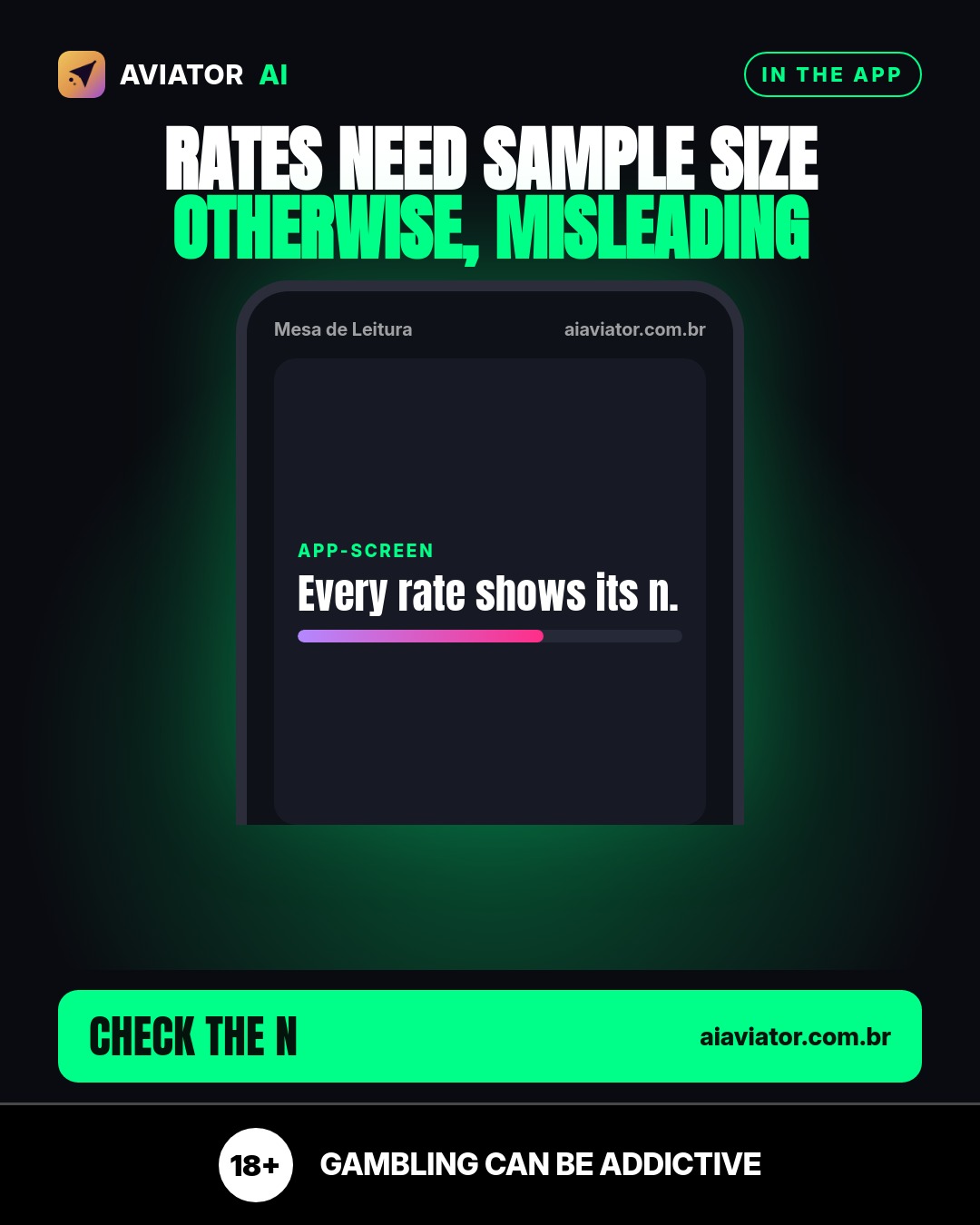
3) “Every rate shows the n”: validate the size before trusting the number
The phrase “Every rate shows the n” sums up a checking behavior: before accepting the number as a reference, verify whether there is sample behind it. When the “n” doesn’t appear, you’re left without the main thing: the path that connects observation to the result shown.
This attention helps avoid the most common interpretation mistake: confusing a displayed number with a conclusion. The app may show a rate to make reading easier, but that doesn’t mean it was supported by a sufficient base to guide decisions.
With Aviator AI, the recommendation is to use rate as a component within an observed context, not as an isolated rule. In other words: rate is “a clue”, not a substitute for sample. When context is clear, the reading becomes more honest; when sample is missing, it becomes just a number.
In the app
In Aviator AI, the bridge to understanding rate is in the product’s own flow: you follow what the system monitors and the predictions it generates, always supported by an observation history (such as 1.295.724 monitored rounds) and by the operational reading volume (like 1.910.608 predictions generated). That way, rate stops being only a number on the screen and becomes part of a vision built with context.
Responsible gambling is a priority: if you choose to play, do so with awareness, within what’s sustainable for you and without trying to “recover” losses. Informational content, 18+ and no gain promise.
Frequently asked questions
Why can rate alone be misleading?
Because “A rate without sample size is just a guess.” Without the sample size, the rate doesn’t have enough basis to consistently represent behavior.
How much observation does Aviator AI use as context for rate?
Since measurement began, there are 1.295.724 monitored rounds.
What shows that the system generates a reading continuously, not only at specific moments?
The product has already generated 1.910.608 predictions.
Share